What We Must Remember
Linked poems by the award-winning authors of NO CHOICE BUT TO FOLLOW (BR #96), Christy Passion, Ann Inoshita, Juliet S. Kono, and Jean Yamasaki Toyama.
Winner of the Hawai‘i Book Publishers Association’s Ka Palapala Po‘okela Honorable Mention for Excellence in Literature
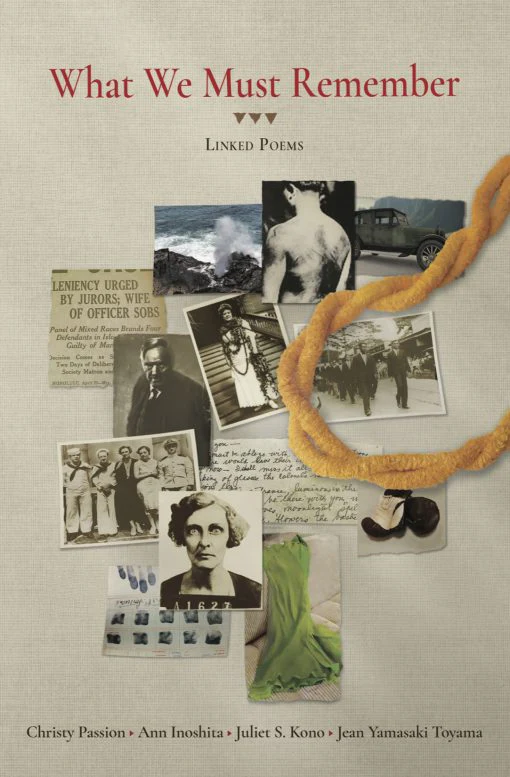
What We Must Remember features 28 linked poems, followed by insightful commentary on each poem by its author. With an introduction and timeline of events by Massie scholar John P. Rosa, this special issue revisits the 1932 kidnapping and murder of Native Hawaiian prize fighter Joseph Kahahawai and the events surrounding it, commonly known as “The Massie Case.”
Referred to as “one of the greatest criminal cases of modern times” by the Chicago Tribune, the incident was reflective of the racial tensions in plantation-era Hawaiʻi and, according to scholar David Stannard in his book Honor Killing, “provided the seedbed for subsequent [social] change” in the local community. In this new book, each poet investigates, interrogates, and brings to light the racial, ethical, and moral complexities of one of Hawaii's most controversial criminal cases, the linked verses interwoven with factual detail to create a mosaic of emotional depth that explores the implications of the historical events that took place and that continue to reverberate today.
Description
Linked poems by the award-winning authors of NO CHOICE BUT TO FOLLOW (BR #96), Christy Passion, Ann Inoshita, Juliet S. Kono, and Jean Yamasaki Toyama.
Winner of the Hawai‘i Book Publishers Association’s Ka Palapala Po‘okela Honorable Mention for Excellence in Literature
What We Must Remember features 28 linked poems, followed by insightful commentary on each poem by its author. With an introduction and timeline of events by Massie scholar John P. Rosa, this special issue revisits the 1932 kidnapping and murder of Native Hawaiian prize fighter Joseph Kahahawai and the events surrounding it, commonly known as “The Massie Case.”
Referred to as “one of the greatest criminal cases of modern times” by the Chicago Tribune, the incident was reflective of the racial tensions in plantation-era Hawaiʻi and, according to scholar David Stannard in his book Honor Killing, “provided the seedbed for subsequent [social] change” in the local community. In this new book, each poet investigates, interrogates, and brings to light the racial, ethical, and moral complexities of one of Hawaii's most controversial criminal cases, the linked verses interwoven with factual detail to create a mosaic of emotional depth that explores the implications of the historical events that took place and that continue to reverberate today.